Artificial intelligence used to be the sort of technology most people encountered without thinking about it. It filtered spam, ranked search results, recommended movies and helped cameras recognize faces. Then generative AI arrived in the mainstream. Suddenly a computer could write an essay, create an image, explain a scientific paper, generate software code or hold a remarkably fluid conversation.
That change made one question unavoidable: what exactly is AI?
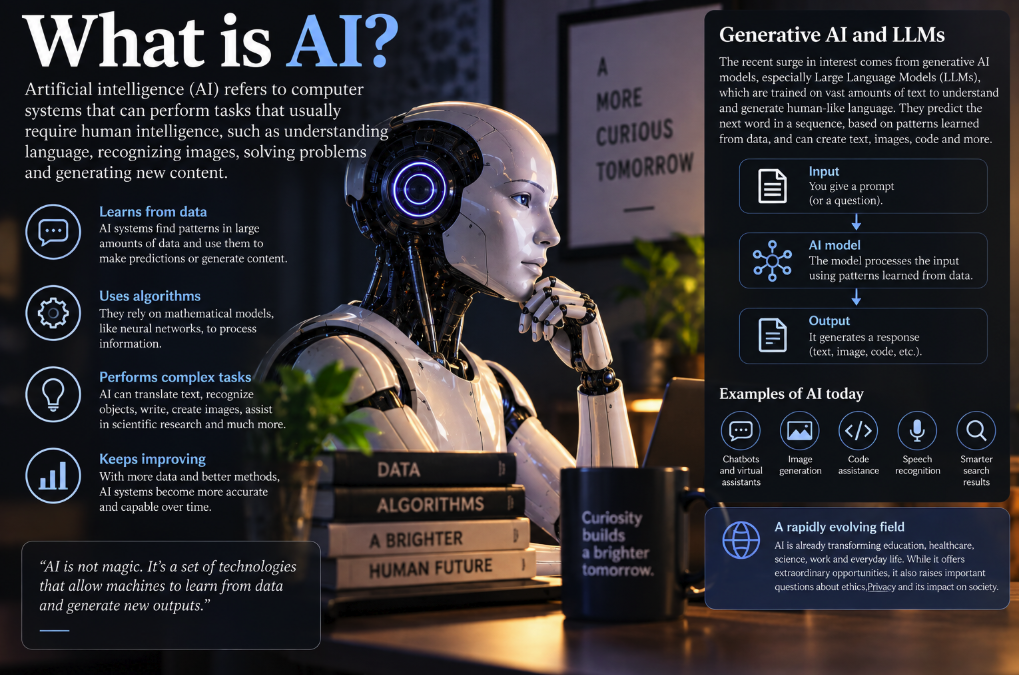
The simplest useful answer is that artificial intelligence is a broad family of computer technologies designed to perform tasks associated with intelligent behavior — such as recognizing patterns, interpreting language, making predictions, solving problems, recommending actions or generating new content. It is not one algorithm, one machine or one kind of software.
And despite the way we casually talk about AI “thinking,” modern artificial intelligence does not work by placing a miniature human mind inside a computer. Most of today's breakthroughs come from mathematical models trained to detect and exploit extraordinarily complicated patterns in data.
AI is an umbrella, not a single technology
Even specialists do not use one universally accepted definition of artificial intelligence. The boundaries have shifted throughout the field's history as once-impressive capabilities became ordinary computing.
The U.S. National Institute of Standards and Technology lists several definitions in its AI terminology. One widely useful formulation describes AI as a machine-based system that, for human-defined objectives, can make predictions, recommendations or decisions that influence real or virtual environments.
That definition is deliberately broad. A fraud-detection system can be AI. So can software identifying tumors in medical images, a self-driving vehicle interpreting the road, a recommendation engine predicting which song you might enjoy and a chatbot generating an answer to a question.
AI therefore should not be confused with generative AI. Generative systems are one increasingly important branch of a much larger field.
The modern AI landscape is easiest to understand as a set of overlapping layers. Artificial intelligence is the broadest category. Inside it sits machine learning, which builds systems that learn useful patterns from data. Deep learning is a branch of machine learning based on neural networks with multiple computational layers. Generative AI commonly uses deep-learning models to create new text, images, audio, video, code and other content.
How does a machine “learn”?
Traditional programming often works by giving a computer explicit rules. If a condition occurs, execute a particular instruction. That approach remains enormously useful, but some problems are too complicated to describe with a manageable list of hand-written rules.
Imagine trying to program every possible visual rule distinguishing a cat from a dog. Ear shapes vary. Fur colors overlap. Animals appear at different angles, distances and lighting conditions. Writing instructions for every possibility quickly becomes impractical.
Machine learning approaches the problem differently. Instead of specifying every visual rule, developers can train a model using data. During training, mathematical parameters inside the model are adjusted so that its predictions become more useful according to an objective.
NIST describes machine learning as the development and use of computer systems that adapt and learn from data with the goal of improving accuracy. Depending on the technique, training might involve labeled examples, patterns discovered without human labels, feedback from rewards, or data that supplies its own training signal.
After training, the model can apply what it has learned to inputs it has not encountered in exactly that form before. That ability to generalize is one reason machine learning became so powerful.
But “learning” here has a technical meaning. It does not automatically imply awareness, understanding or human-like experience. It means that the system's internal parameters have been optimized from data in ways that improve performance on a task.
What are neural networks?
Many of today's most capable AI systems use artificial neural networks. Their name comes from a loose historical inspiration from biological neurons, but modern neural networks should not be mistaken for digital replicas of the human brain.
A neural network consists of layers of mathematical units that transform numerical representations. During training, the strengths of connections — represented by parameters often called weights — are adjusted. With enough layers, data and computation, networks can learn complex representations that are useful for recognizing images, processing speech, translating languages and generating content.
Deep learning refers to machine learning built around networks containing multiple processing layers. Its rise was accelerated by larger datasets, improvements in algorithms and the enormous parallel computing power available from modern processors.
The result was a sequence of breakthroughs. Machines became dramatically better at recognizing objects and speech. Translation improved. Then a neural-network architecture introduced in 2017 — the transformer — helped reshape language AI.
What is an LLM?
A large language model, or LLM, is a model trained on enormous amounts of language-related data to learn statistical and structural relationships within sequences of tokens. Tokens can represent words, pieces of words, punctuation and other elements.
GPT, for example, stands for Generative Pre-trained Transformer. NIST defines GPT as a family of machine-learning models based on the transformer architecture and pretrained through self-supervised learning on large datasets of unlabeled text. Transformers are now the dominant architecture behind modern LLMs.
One of the central training tasks for an autoregressive language model is deceptively simple: predict what token should come next.
Given “The capital of France is …”, the model learns that “Paris” is an extremely plausible continuation. But training at enormous scale forces the network to learn far more than isolated phrases. To predict language effectively, a model benefits from representing grammar, relationships between concepts, writing styles, facts present in its training data, patterns of reasoning, computer code and many other structures.
When a user enters a prompt, the model processes that context and calculates probabilities for possible next tokens. It selects a continuation, incorporates that new token into the context and repeats the process. Token by token, a paragraph emerges.
This is why describing an LLM as “just autocomplete” is both illuminating and misleading. Next-token prediction is fundamental to how many LLMs are trained and generate text, but the models performing that prediction can contain billions of learned parameters and surprisingly rich internal representations. Modern assistants may also be further trained with human or AI feedback, connected to tools, given external information, and built into systems that perform multi-step tasks.
What makes generative AI different?
For decades, much commercial AI focused on classification and prediction: Is this transaction fraudulent? Which advertisement should appear? Is there a pedestrian in this image?
Generative AI changes the visible output. NIST defines generative artificial intelligence as models that emulate characteristics and structure in input data to generate derived synthetic content, including text, images, video and audio.
Different generative systems use different architectures. LLMs specialize in language and related symbolic sequences. Image generators may use diffusion models that learn to construct images through iterative denoising. Multimodal systems can work across combinations of text, images, audio and video.
What they share is the ability to produce outputs rather than merely assign an input to a category. That shift is why generative AI feels so different to ordinary users: instead of operating invisibly behind an app, the model becomes something people can directly instruct.
Does AI understand what it is saying?
This question is harder than it first appears because “understand” can mean several different things.
Modern AI can form internal representations that allow it to answer questions, translate concepts, manipulate abstractions and perform tasks that require substantial contextual sensitivity. Calling all of that simple memorization misses important capabilities.
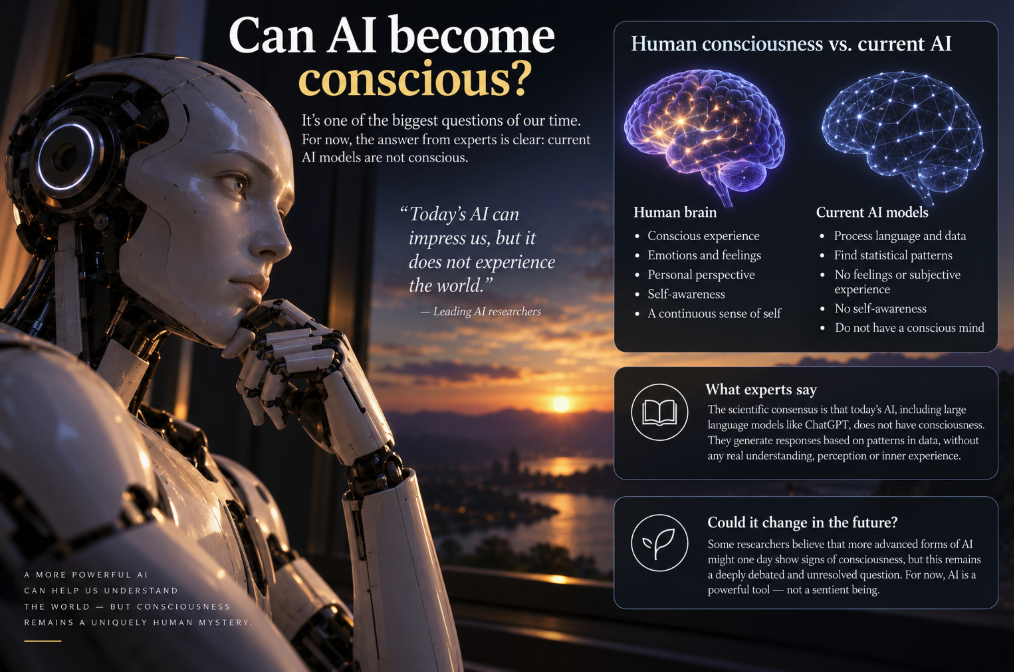
But fluent output does not prove human-like comprehension or consciousness. An LLM has no automatic guarantee that a plausible sentence is true. Its training objective rewards useful prediction of patterns, not possession of a perfect database of reality. This is one reason generative systems can confidently produce false statements, a failure commonly called hallucination.
AI can also inherit biases and errors from data, fail when conditions differ from its training, and behave unpredictably in edge cases. More capability does not eliminate the need for verification.
This distinction matters because conversational interfaces encourage anthropomorphism. A model says “I think” because that is natural language, not because the phrase itself proves the existence of a private inner experience.
Why AI suddenly seems to be everywhere
Artificial intelligence is not new. The academic field dates to the 1950s, and machine-learning systems have influenced daily life for years. What changed recently was the combination of model scale, computing power, vast digital datasets and interfaces simple enough for anyone to use.
Generative AI transformed AI from background infrastructure into a visible collaborator. People no longer needed to know how to program a machine-learning system. They could simply type a request in ordinary language.
That accessibility has pushed AI into software development, education, research, medicine, design, customer service, entertainment and office work. It has also intensified unresolved questions about copyright, privacy, misinformation, labor, energy use, security, bias and how much authority humans should delegate to automated systems.
So what is AI? At its core, it is not magic and it is not one synthetic brain. It is a broad field of computational techniques for building machines that can perform tasks we associate with intelligent behavior. Machine learning allows many of those systems to acquire useful patterns from data. Deep neural networks make increasingly complex representations possible. Generative models turn those learned patterns into new content, while LLMs apply the approach to language at extraordinary scale.
The remarkable part is not that a machine secretly became human. It is that mathematics, data and computation can reproduce so many abilities that once seemed to require a human mind — and that we are still discovering where the boundary lies.