A mosquito bite is usually an itchy annoyance that disappears within a few days. During summer and early autumn in the United States, however, one particular mosquito-borne infection repeatedly returns to public-health alerts and search trends: West Nile virus.
The virus is now established across the continental United States and, according to the Centers for Disease Control and Prevention, is the country's leading cause of mosquito-borne disease in the contiguous states. Most infected people never know they have it. A much smaller group develops a feverish illness, and a tiny fraction develops a dangerous infection involving the brain, spinal cord or surrounding tissues.
That combination—common exposure to mosquitoes, mostly invisible infections and a rare but potentially severe outcome—helps explain why reports of local West Nile activity can make symptoms and prevention suddenly become urgent search terms.
What is West Nile virus?
West Nile virus, often abbreviated WNV, belongs to the flavivirus group. It was first identified in Uganda in 1937 and was detected in the United States in New York in 1999. It subsequently spread across the country.
Its natural transmission cycle is primarily between birds and mosquitoes, particularly mosquitoes in the genus Culex. A mosquito feeds on an infected bird, becomes infected and can later transmit the virus when it bites another bird or a person.
Humans are generally considered “dead-end” hosts. In ordinary infections, people do not develop enough virus in their blood to infect new mosquitoes that bite them, so West Nile does not normally spread from one person to another through everyday contact.
Rare transmission has occurred through blood transfusion, organ transplantation, laboratory exposure and from mother to baby during pregnancy, delivery or breastfeeding. It does not spread through coughing, sneezing or casually touching another person.
The CDC's current West Nile virus guidance notes that U.S. infections occur mainly during mosquito season, typically from summer into fall, with diagnoses generally peaking around late August and early September.
Most infected people have no symptoms
One of the most important facts about West Nile is that infection and illness are not the same thing. The CDC estimates that about 80 percent of infected people develop no symptoms at all. They may never realize they encountered the virus.
Among people who do become sick, symptoms usually begin several days after the bite. The typical incubation period is around two to six days, although the CDC gives an overall range of two to 14 days and notes that it can be longer in people with weakened immune systems.
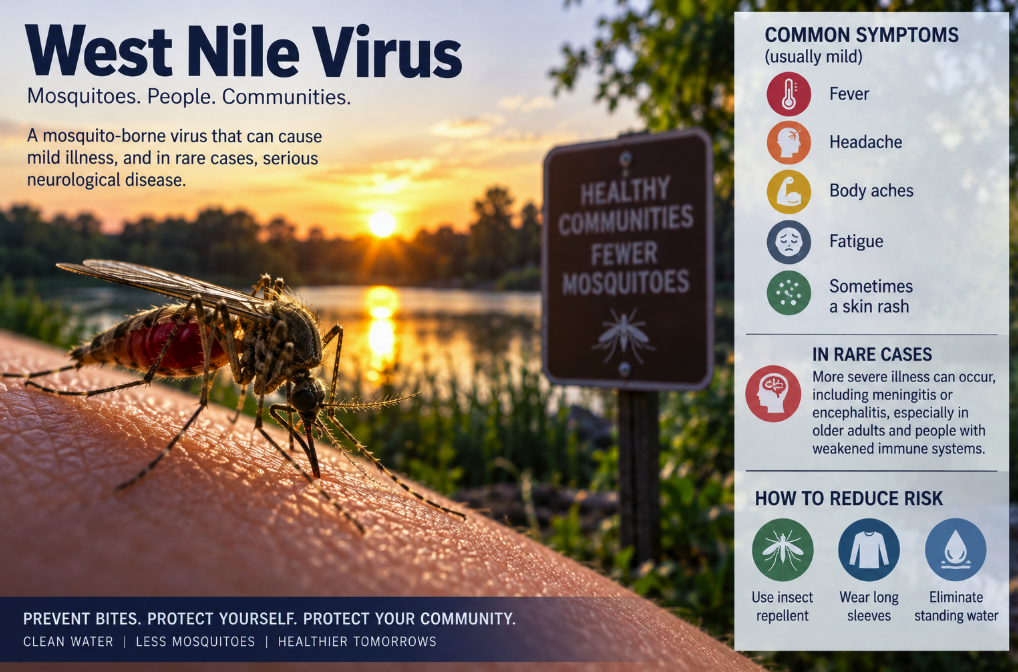
Roughly one in five infected people develops what is often called West Nile fever, a non-neurologic illness. Symptoms can include fever, headache, fatigue, body or joint aches, vomiting, diarrhea and a skin rash.
For most people in this group, the illness resolves without specialized treatment. Recovery is not always instantaneous, however. Fatigue and weakness can linger for weeks or even months after the acute illness has passed.
These symptoms are also nonspecific. Fever, headache and body aches occur with many infections, so symptoms alone cannot tell someone that they have West Nile virus. A clinician may consider mosquito exposure, local virus activity, the clinical picture and laboratory testing when evaluating a suspected case.
When West Nile becomes dangerous
Fewer than 1 percent of infected people develop neuroinvasive West Nile disease, but this is the form that makes the virus medically serious. It can cause meningitis, inflammation of the membranes surrounding the brain and spinal cord; encephalitis, inflammation of the brain; or an acute flaccid paralysis syndrome that can resemble poliomyelitis.
Warning signs can include high fever, severe headache, neck stiffness, confusion, disorientation, tremors, seizures, pronounced muscle weakness, numbness, vision changes, paralysis, stupor or coma.
These are not symptoms to monitor casually at home while waiting to see whether they disappear. The CDC advises immediate medical attention for concerning neurologic symptoms such as high fever with neck stiffness, confusion, tremors or muscle weakness.
Severe disease can require hospitalization and supportive care. Recovery may take weeks or months, and some neurologic effects can persist. CDC clinical guidance estimates mortality at approximately 10 percent among patients who develop neuroinvasive West Nile disease, although an individual's prognosis depends on the type and severity of illness and other health factors.
Who is at greater risk of severe illness?
Anyone exposed to an infected mosquito can become infected, but the probability of severe disease is not evenly distributed. Risk rises with age, particularly among older adults. People with weakened immune systems and certain underlying medical conditions also face greater risk.
MedlinePlus identifies factors associated with serious disease including older age, organ transplantation and conditions such as cancer, diabetes, high blood pressure and kidney disease. Immunosuppressive treatments can also increase vulnerability.
This does not mean a younger healthy person cannot become seriously ill. It means severe outcomes become more likely in particular groups, which is why mosquito-bite prevention is especially important for people at elevated risk.
Why late summer matters
West Nile is closely linked to the ecology of mosquitoes and birds. Infected birds help amplify the virus in nature; mosquitoes acquire it from those birds and subsequently transmit it to other hosts. As mosquito populations and viral circulation build during warm months, human risk can rise.
In the United States, that is why West Nile searches tend to accelerate in late summer and early fall. The CDC says diagnoses typically peak from late August into early September.
The 2026 season attracted particular attention early. On July 1, the CDC reported that the country had recorded its earliest West Nile season start and the highest number of reported human infections by that point in the year since 2004. At least 48 cases had been reported by June 30, including 38 cases of severe neuroinvasive disease.
Those figures were an early-season snapshot, not a final total. West Nile surveillance is continuously updated, and CDC cautions that national data are preliminary and affected by reporting delays. State and local health departments may have more current information for a specific community.
There is no licensed human West Nile vaccine
There is currently no licensed vaccine to prevent West Nile virus disease in people and no specific antiviral medicine proven to cure it. Antibiotics do not work because West Nile is caused by a virus, not bacteria.
Treatment is therefore supportive. People with mild disease may need rest, fluids and appropriate medication for symptoms. Severe neurologic disease often requires hospitalization for intravenous fluids, respiratory support, seizure management, nursing care or other treatment depending on complications.
That makes prevention unusually important: the most effective intervention for the general public happens before an infected mosquito bites.
How to reduce your risk of West Nile virus
The CDC recommends using an insect repellent registered with the U.S. Environmental Protection Agency and following its label instructions. Clothing also creates a simple physical barrier: long, loose-fitting sleeves and pants make exposed skin less accessible to mosquitoes.
The mosquitoes that commonly transmit West Nile are particularly active from dusk to dawn, so limiting exposure during those periods can reduce risk. Window and door screens and air conditioning, where available, help keep mosquitoes outside.
Standing water around homes deserves attention because it can provide mosquito breeding habitat. Buckets, plant saucers, discarded containers and other objects that collect water should be emptied and cleaned regularly. Some permanent water sources can be treated with appropriately labeled larvicides, while larger mosquito problems may require local mosquito-control professionals.
Community control matters too. When surveillance detects infected mosquitoes or unusually high mosquito numbers, public-health agencies may use larvicides or adult mosquito-control measures to reduce transmission risk.
These measures cannot make mosquito exposure zero, but they reduce the opportunity for the virus to complete the final step from an infected mosquito to a human host.
A mosquito bite does not mean you have West Nile
The sudden appearance of a mosquito bite can become alarming after hearing about West Nile activity nearby. But most mosquito bites do not result in West Nile infection, and even most people who are infected never develop symptoms.
There is also no useful way to look at a bite and determine whether the mosquito carried West Nile virus. The familiar red, itchy bump is an immune reaction to mosquito saliva, not a visual test for the virus.
If you develop concerning illness after mosquito exposure—particularly high fever, severe headache, neck stiffness, confusion, significant weakness, tremors or other neurologic symptoms—seek medical evaluation promptly. For milder symptoms, a healthcare professional can help determine whether testing or additional evaluation is appropriate, especially if local West Nile activity has been reported.
The most useful response to West Nile is therefore neither panic over every mosquito nor indifference to the risk. The virus is widespread, severe disease is uncommon, and simple bite-prevention habits can meaningfully reduce exposure. In mosquito season, that is knowledge worth carrying outside with the repellent.