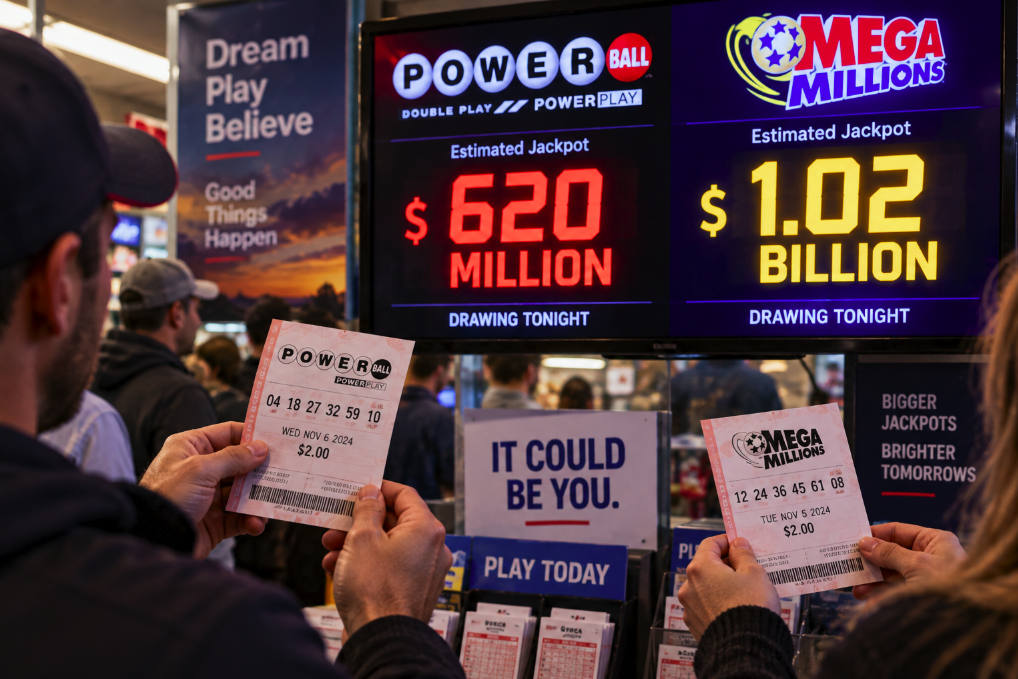
Few numbers can transform an ordinary convenience-store counter into a national obsession as quickly as a giant lottery jackpot. Once Powerball or Mega Millions climbs into the hundreds of millions of dollars—and especially when the headline figure crosses the billion-dollar mark—Americans begin searching for the same things at enormous scale: tonight's drawing time, the winning numbers, whether anyone hit the jackpot and how large the next prize will be.
The spectacle can make the lottery feel complicated, but the machinery behind the excitement is fairly simple. A jackpot grows when drawings pass without a ticket matching every number required for the top prize. More people then notice the larger jackpot, more tickets are sold, and the next advertised prize can grow faster. The result is a feedback loop in which rarity creates size and size creates attention.
What does not change is the central mathematical fact: an enormous jackpot is enormous precisely because winning it is extraordinarily unlikely.
Powerball and Mega Millions are not ordinary state lotteries
Powerball and Mega Millions are multijurisdictional games, which allows ticket sales from a huge population to contribute to major prizes. They are offered through participating U.S. lotteries rather than functioning as one independent nationwide lottery authority.
Players choose numbers from separate pools: a group of main numbers plus a special Powerball or Mega Ball. The precise game rules, ticket prices and number matrices can change over time, so anyone playing should verify the current format on the official Powerball or Mega Millions site rather than relying on an old article, screenshot or social post.
To win the jackpot, a ticket must match the complete jackpot combination for that game. Tickets that match only some of the numbers can still win smaller prizes according to the game's prize structure.
That distinction explains why a drawing can produce many winners while the jackpot still rolls over. Thousands or even millions of tickets may win something without any ticket matching the exact combination needed for the grand prize.
Why jackpots roll into astronomical territory
Imagine a drawing in which nobody matches all the required numbers. Instead of awarding the jackpot, the game carries the top prize forward. Money generated for the jackpot by subsequent ticket sales is then added to it. If nobody wins again, the process repeats.
After several rollovers, the advertised prize becomes newsworthy. Occasional players who ignored a smaller jackpot begin buying tickets. Office pools form. Friends text one another. News outlets report the growing figure. Search traffic increases. Higher sales can then help push the advertised jackpot upward more quickly before the next drawing.
This is why jackpot growth is not perfectly linear. A prize can climb modestly early in a run and then accelerate once the headline itself becomes a cultural event.
The system also explains an apparent paradox: lotteries benefit from producing winners, but gigantic jackpots depend on long stretches in which nobody wins the top prize. Game designs balance the possibility of smaller prizes with extremely difficult jackpot odds.
The advertised jackpot is usually not a suitcase full of cash
When a sign says a jackpot is worth hundreds of millions of dollars, the headline amount generally refers to the annuity option, in which the prize is paid over a long period according to the game's rules.
A jackpot winner typically also has a lump-sum cash option. That cash amount is lower than the advertised annuity value because it represents the present cash value associated with funding the longer payment stream.
Then come taxes. Lottery prizes are taxable income under U.S. federal law, and state or local taxes may also apply depending on where the winner lives and where the ticket was purchased. The number on the billboard is therefore not the amount a typical jackpot winner would simply deposit into a checking account the next morning.
For very large wins, financial and legal planning can become almost as consequential as checking the ticket itself. Rules about claiming anonymously also vary by jurisdiction, so winners should consult the lottery that sold the ticket and qualified professional advisers rather than assume privacy works the same everywhere.
Do some numbers have a better chance of winning?
No valid number combination is magically “due.” Lottery drawings are designed to be random, and previous drawings do not cause particular numbers to become more likely in the next independent drawing.
If a number has not appeared for weeks, that does not mean the machine owes it an appearance. If the same number appeared recently, that does not make it exhausted. The belief that past random outcomes should force future ones to balance out in the short term is known as the gambler's fallacy.
Birthdays, lucky numbers, anniversaries, computer-generated quick picks and elaborate personal systems may make choosing a ticket more entertaining, but they do not give a combination supernatural predictive power.
There is one subtle practical distinction that is sometimes confused with improving the odds of winning. Choosing combinations that other people are less likely to choose could, in theory, reduce the chance of having to split a jackpot if that combination wins. It does not make the combination more likely to be drawn.
Why the odds are so difficult to feel intuitively
Human beings are not naturally good at imagining probabilities measured in hundreds of millions to one. A jackpot ticket creates a vivid possible future—a house, travel, retirement, help for family—while the overwhelming probability of losing is abstract and emotionally quiet.
That mismatch is part of the lottery's psychological power. The ticket does not merely purchase a statistical chance; for many players it purchases a few days of imagining what they would do if an extraordinary event happened.
The important boundary is recognizing the difference between entertainment and financial planning. Buying more tickets increases the number of combinations you hold, but it does not transform a tiny probability into a sensible investment strategy. Money needed for rent, bills, food, debt payments or savings should not depend on a lottery outcome.
Why “winning numbers” searches explode after a drawing
A lottery drawing produces an unusually concentrated information event. Millions of tickets can remain unchecked until a handful of balls establish their value in seconds. Immediately afterward, people search the numbers, jackpot status and location of any winning ticket.
The information is also extremely time-sensitive. Yesterday's Powerball combination is useless to someone checking tonight's ticket. Search engines consequently see large bursts of near-identical queries around drawing nights, especially when the jackpot has reached a psychologically dramatic threshold.
For current results, the safest approach is to use the official game website and the official lottery in the state or jurisdiction where the ticket was purchased. A ticket should be checked carefully before being discarded, because a non-jackpot ticket can still qualify for a smaller prize.
Players should also be wary of messages claiming they won a lottery they never entered, especially if someone asks for an advance fee, bank information or payment to “release” the prize. Legitimate lottery winnings do not require paying a stranger through an unsolicited message to unlock imaginary money.
What happens when more than one ticket hits the jackpot?
If multiple tickets match the jackpot combination in the same drawing, the jackpot is shared according to the game's rules. The possibility is rare but entirely plausible, especially when enormous jackpots drive exceptionally high ticket sales and therefore put more combinations into play.
This is another reason the advertised jackpot should be understood as a headline estimate rather than a guaranteed personal payout. A winner may choose between payment structures, owe taxes and, in a multiple-winner drawing, share the top prize.
The strange economics of a billion-dollar dream
Powerball and Mega Millions have become more than games. Giant jackpot runs function as recurring pieces of American popular culture. Coworkers who never discuss probability organize pools. Television stations report the number alongside weather and sports. Convenience stores display enormous illuminated figures. People who normally never buy lottery tickets decide that a billion dollars is somehow different.
Mathematically, the ticket remains a long shot. Psychologically, the extra zero changes everything.
That tension explains the daily search frenzy. People are not only asking which balls came out of a machine. They are checking whether an almost impossible alternative life has suddenly become real.
For nearly everyone, the answer will be no. That is precisely why the jackpot can become so enormous in the first place—and why, when nobody wins, millions of people will look up the next drawing and imagine it all over again.