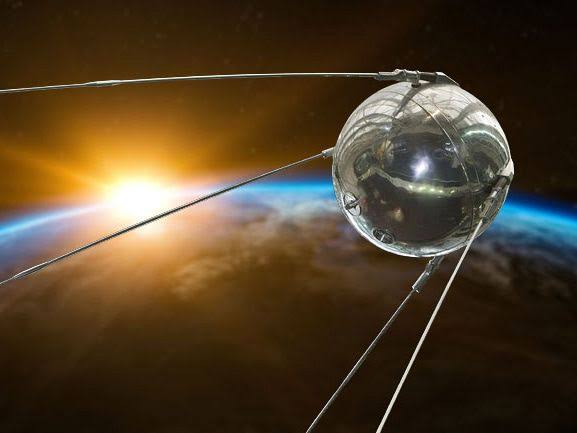
The idea of launching an object into space was born of a scientific and political ambition that changed the course of history. The first artificial satellite, launched in 1957, was not just a technological innovation, but a symbol of power and progress. Who created it? What were its purposes? And how did this idea arise? This article explores the birth of the satellite, the historical context that made it possible, and the role it played in the competition between world powers. Through a simple and direct narrative, we will discover how a seemingly small object sparked a revolution.
The history of the satellite begins in 1957, when a group of scientists and engineers from a communist country decided to launch an object into space. It wasn't a crazy idea, but an ambitious project born from an extremely heated geopolitical context. The first artificial satellite, called Sputnik 1, was launched by the Soviets on October 4, 1957, marking the beginning of the so-called "Space Cold War."
The decision to launch a satellite was not a coincidence. It was a way to demonstrate a country's technological superiority, but also to explore the possibilities of space exploration. Sputnik was a small object, about 58 cm in diameter and weighing 83.6 kg, which transmitted radio signals while orbiting the Earth. Its function was simple yet revolutionary: to test whether it was possible to maintain an object in orbit and collect data on the Earth's atmosphere.
But the significance of that launch was much greater. For the Soviets, Sputnik was a symbol of power. For the Americans, it was a warning signal. The competition between the two blocs intensified, and the satellite became the center of a global debate. While the world watched the skies, science advanced.
In the years that followed, the satellite was not just a symbol, but an innovation that changed daily life. The technology developed for Sputnik led to new forms of communication, navigation, and research. Today, satellites are everywhere: they give us phone signals, allow us to navigate, and help us monitor the climate.
But how did this idea come about? The answer lies in a mix of scientific curiosity, political challenge, and ambition. Who invented the satellite? Not a single man, but a team of engineers, physicists, and politicians who believed in a different future. Their work was the first step toward a revolution.
For science enthusiasts, the satellite is an example of how a simple idea can transform into a momentous innovation. It wasn't just a technological experience, but an opportunity to look at the world differently. That's why the satellite remains a symbol of progress.