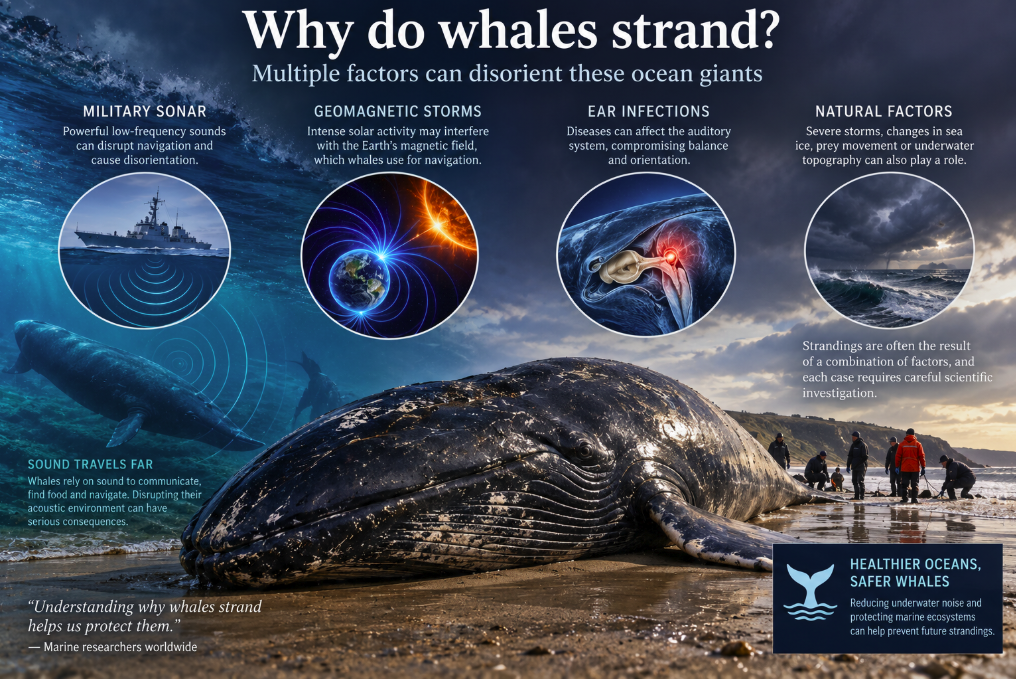
Few wildlife events are as disturbing as a whale stranding. An animal exquisitely adapted to life in deep water suddenly lies helpless on a beach, sometimes alone and sometimes alongside dozens or even hundreds of members of its group. The obvious question — why did it come ashore? — often has no obvious answer.
There is no single cause of whale strandings. Necropsies and field investigations have linked individual events to disease, starvation, harmful algal toxins, ship strikes, fishing gear, unusual ocean conditions and other factors. Social behavior can turn the misfortune of one animal into a mass event when tightly bonded companions follow it into shallow water. In many cases, decomposition or lack of evidence means the cause remains unknown.
Three explanations attract particular fascination because they involve the whales' extraordinary sensory world: powerful military sonar, disturbances in Earth's magnetic field and diseases or injuries that impair hearing. All three have been investigated scientifically. They do not, however, have equal levels of evidence behind them.
Military sonar: the link scientists take seriously
The strongest acoustic evidence concerns certain deep-diving beaked whales and mid-frequency active sonar used in naval anti-submarine operations. NOAA Fisheries states that mass strandings of deep-diving whales have, in some cases, been causally linked to military sonar. Historical incidents associated with naval exercises have occurred in places including the Bahamas, Canary Islands, Greece and the Mariana Archipelago.
Beaked whales are unusually specialized divers. Cuvier's beaked whales can descend to extraordinary depths and remain underwater for well over an hour. During a normal dive, their bodies manage enormous pressure changes and nitrogen loads. A sudden, intense behavioral response to an unfamiliar acoustic threat may disrupt that carefully controlled diving pattern.
One leading hypothesis is therefore not simply that sonar “deafens” the whale. The sound may frighten or disturb a sensitive animal enough to change how it dives. If it ascends or alters its dive profile abnormally, nitrogen can form bubbles in tissues and blood vessels, producing injuries compared with decompression sickness in human divers. Necropsies of some sonar-associated beaked-whale strandings have revealed gas-bubble lesions, fat emboli, hemorrhage and congestion in tissues.
The association is unusually compelling in certain events. NOAA researchers examining Cuvier's beaked-whale strandings in the Mariana Archipelago found that three of eight recorded stranding events occurred during or within six days of naval anti-submarine sonar operations. Their statistical analysis indicated that the probability of this timing being coincidental was less than one percent.
That does not mean every naval exercise strands whales, nor that every beaked-whale stranding is caused by sonar. NOAA notes that scientists still do not completely understand the mechanism, and many strandings occur without documented sonar exposure. The animal's species, distance from the source, received sound level, local underwater acoustics and previous exposure may all affect the response.
It is also important not to treat every device called “sonar” as equivalent. Oceanographers routinely use sound to map the seabed — a technique discussed in IMOOND's exploration of how scientists map the Mariana Trench and the deep ocean — but systems differ enormously in frequency, power, beam shape and purpose. Tactical military sonar cannot simply be equated with every acoustic instrument used at sea.
Can sound actually damage a whale's hearing?
For toothed whales and dolphins, hearing is fundamental. They use echolocation clicks to investigate their surroundings and find prey, while acoustic communication helps maintain contact with other animals. Severe hearing impairment could therefore be profoundly disabling.
Researchers have found major hearing deficits in some stranded cetaceans. In a study using auditory evoked potentials — conceptually similar to objective hearing tests used in humans — scientists examined stranded or entangled toothed cetaceans from several species. Significant hearing loss was found in four of seven bottlenose dolphins and five of 14 rough-toothed dolphins tested, while one stranded short-finned pilot whale had profound hearing loss. Other stranded animals in the study had normal measured hearing.
The finding demonstrates that hearing impairment exists among stranded cetaceans, but it does not by itself prove what caused the hearing loss or whether deafness caused the stranding. An animal might have lost hearing because of age, disease, acoustic exposure or another injury. Establishing cause and effect after death is particularly difficult because the delicate sensory cells of the inner ear deteriorate rapidly.
Pathologists have developed specialized techniques to examine cetacean cochleae for cellular damage compatible with excessive noise. Some stranded animals have shown sensory-cell loss consistent with acoustic trauma, while many others have not. Even when hemorrhage is found around auditory structures, investigators must be cautious because bleeding can also occur from the physical trauma and physiological stress of stranding itself.
Disease offers another route to sensory failure. Researchers have documented bacterial, fungal and parasitic infections of cetacean ears. A 2026 case report described a stranded melon-headed whale in Brazil with both middle ears heavily infected by nematode worms, producing chronic inflammation and obstruction. Earlier work on harbor porpoises has similarly found severe fungal or parasitic ear disease capable of impairing hearing.
An animal that cannot hear normally may struggle to echolocate, forage or orient itself. Yet ear disease remains one possible contributor among many rather than a universal explanation for beaching.
What about solar storms and Earth's magnetic field?
The geomagnetic hypothesis is more speculative but scientifically intriguing. Many migratory animals possess some form of sensitivity to Earth's magnetic field, and researchers have long wondered whether cetaceans also use magnetic information as part of navigation. If so, magnetic anomalies or rapid disturbances caused by solar activity might conceivably distort an internal compass.
NASA scientists joined marine-mammal researchers to test this idea using records of strandings and space weather. The hypothesis was attractive because solar eruptions can disturb Earth's magnetosphere on a planetary scale, potentially providing an environmental event capable of affecting animals far from one another.
The result was not the dramatic answer some headlines implied. In an analysis of Cape Cod strandings, researchers did not find evidence that space weather was the primary driver. Shifting the geomagnetic data relative to the dates of strandings failed to reveal a clear causal relationship. NASA researchers concluded that there was no “smoking gun” connecting solar storms to the events.
They did not completely dismiss magnetism. Geomagnetic conditions might conceivably contribute as one element in a complicated combination of environmental factors. Coastal geography is also relevant: gently sloping beaches, fine sediments, tides and complex shorelines are repeatedly associated with mass-stranding hotspots. A navigation error that would be harmless in deep water can become catastrophic in a bay where the seafloor rises almost imperceptibly.
Sometimes the group itself is the danger
Mass strandings are especially common among highly social toothed whales such as pilot whales. Their cohesion is normally an evolutionary advantage. Animals travel, communicate and protect one another in stable groups. Near shore, that same loyalty can become dangerous.
If a sick, injured or disoriented individual enters shallow water, companions may follow. Rescuers sometimes refloat apparently healthy animals only to see them turn back toward stranded group members. In such cases, the immediate reason dozens of whales reach the beach may be social behavior, even if the original trigger affected only one animal.
Other strandings have very different explanations. NOAA lists disease, harmful algal blooms and biotoxins, malnutrition, pollution, marine debris, fishing-gear entanglement and vessel collisions among known or suspected causes. Weather and unusual oceanographic conditions can also contribute. In a 2015–2016 mortality event involving humpback and fin whales in Alaska and British Columbia, investigators considered sonar among numerous possibilities but ultimately concluded that sonar was unlikely to have contributed; unusual ocean conditions were considered a more plausible factor.
This is why scientists resist explanations that begin with the conclusion. A naval exercise near a stranded whale does not automatically prove sonar caused the event, just as the absence of obvious external wounds does not prove a whale was disoriented. Investigators need timelines, acoustic records, oceanographic data, pathology, toxicology and, whenever possible, exceptionally fresh tissue samples.
The mystery of whale strandings is therefore not one mystery but many. Military sonar has credible causal evidence behind some beaked-whale mass strandings. Hearing loss and ear disease can plausibly disable individual cetaceans. Geomagnetic storms remain an interesting hypothesis but have not emerged as a primary explanation. Social behavior, geography, disease and changing ocean conditions can complete the picture in other events.
Whales live in a sensory environment humans barely experience. To us, the ocean may seem dark and empty. To a cetacean it is an acoustic landscape full of echoes, calls and information. Understanding why that landscape sometimes leads an animal toward shore requires listening to more than one explanation — and accepting that, for many strandings, science still has to say: we do not yet know.