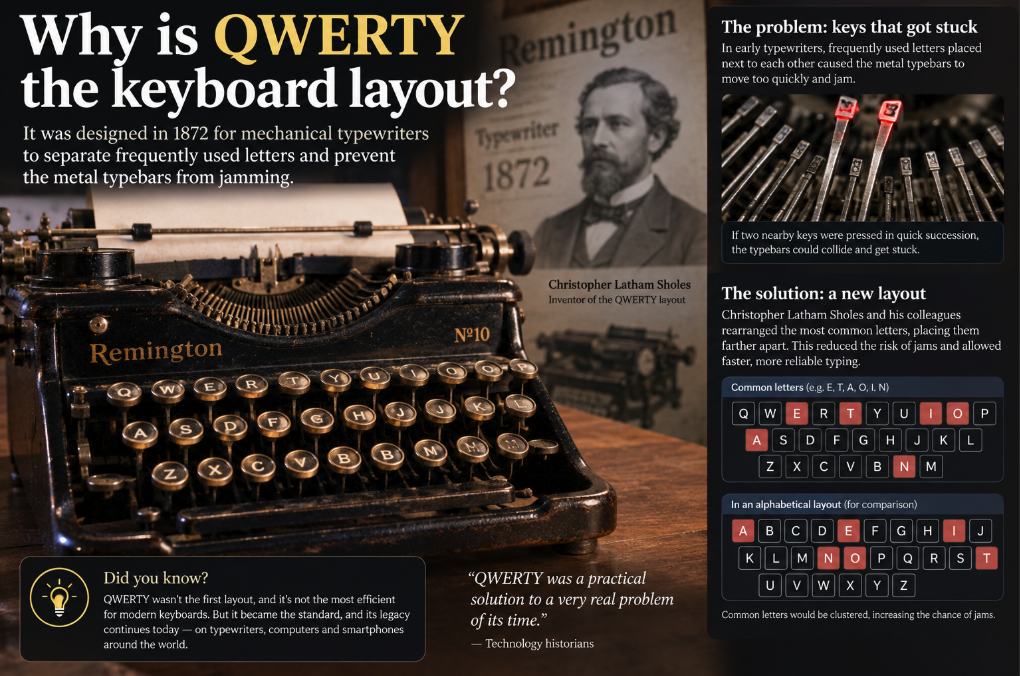
Look down at almost any laptop, desktop keyboard or smartphone in the English-speaking world and the first six letters are the same: Q-W-E-R-T-Y. The arrangement feels so inevitable that it is easy to forget how strange it is. The alphabet begins ABCDEF, yet the machine we use to write has scattered those letters across three rows in an apparently chaotic pattern.
The usual explanation is wonderfully mechanical. Early typewriters had metal typebars that could collide and jam when nearby letters were struck quickly, so inventor Christopher Latham Sholes supposedly separated common letter combinations to keep the machinery running smoothly. That story contains a real engineering problem, but historians no longer treat it as the complete, proven explanation for QWERTY.
The keyboard evolved through years of experimentation in the late 1860s and early 1870s. Mechanical constraints probably mattered, but evidence also points toward another influence: telegraph operators who needed to transcribe Morse code quickly and accurately. What we can say with much more confidence is why QWERTY survived. Once Remington typewriters, professional typists, businesses and training schools adopted it, changing the layout became increasingly expensive. A solution born in the age of levers and ink ribbons became a standard powerful enough to survive computers and touchscreens.
Before QWERTY, the keyboard was almost alphabetical
Christopher Latham Sholes was a Wisconsin newspaper editor, printer, politician and inventor. In the 1860s he worked with Carlos Glidden and Samuel W. Soulé on a machine capable of printing characters onto paper. Their 1868 typewriter patent was one milestone in a much broader international effort to mechanize writing.
The earliest Sholes machines did not begin with QWERTY. Their keys were arranged in ways much closer to alphabetical order, and some prototypes resembled a piano keyboard. Over the following years, Sholes and his collaborators repeatedly changed the design.
By 1873, a machine with a recognizable QWERTY arrangement was demonstrated to E. Remington & Sons. Remington, already experienced in precision manufacturing, agreed to produce the device. The Sholes & Glidden Type Writer went on sale in 1874, becoming the first commercially successful typewriter of its kind.
That chronology matters because QWERTY was not simply invented in a single afternoon in 1872. It emerged gradually from numerous prototypes. As the Smithsonian's history of QWERTY notes, Sholes and Glidden went through around 30 experimental models before settling on the arrangement that transformed typing.
Did QWERTY really stop typewriters from jamming?
Early typewriters had a genuine mechanical weakness. Pressing a key caused a typebar carrying a character to swing toward the paper. If two typebars moved into the same area in rapid succession, they could interfere with one another. A typist then had to stop and separate the mechanism.
This gave rise to the classic QWERTY explanation: Sholes moved commonly consecutive letters apart so their typebars would be less likely to collide.
It is plausible, and versions of the explanation have appeared in museums and technology histories for decades. But the actual QWERTY arrangement does not fit the story as neatly as popular retellings suggest. Some very common English letter pairs remain physically close on the keyboard. E and R, for example, sit side by side.
There is also a persistent myth that Sholes deliberately made typing difficult in order to slow typists down. The evidence for that claim is especially weak. Preventing mechanical conflicts would have been useful, but deliberately crippling the speed of a commercial writing machine would have been an odd selling point.
The Smithsonian's updated examination of the QWERTY legend describes its origin as disputed rather than presenting the anti-jamming story as established fact.
The forgotten telegraph theory
A different explanation emerged from research into the connection between early typewriters and telegraphy. Before telephones became widespread, trained operators received messages encoded in Morse signals and transcribed them into written language. A typewriter could make that work dramatically faster — provided its keyboard suited the operator's needs.
Japanese researchers Koichi Yasuoka and Motoko Yasuoka examined the early development of QWERTY in relation to American telegraph equipment. In their 2011 paper “On the Prehistory of QWERTY”, they argued that the keyboard evolved partly in response to the requirements of Morse receivers rather than simply as an attempt to stop mechanical jams.
American Morse code could make certain signals ambiguous until additional context arrived. One example discussed by the researchers involves the letter Z and the sequence SE. Positioning relevant letters conveniently could help an operator hesitate briefly and then choose the correct transcription once the message became clear.
There is good historical reason to take telegraphy seriously. Sholes' machine was demonstrated to telegraph operators, and one of his earliest typewriters was sold to a telegraph college. The University of Wisconsin's Wisconsin 101 project concludes that the mechanical and telegraphic explanations may both contain pieces of the story.
That is probably the safest way to understand QWERTY. It was an evolving 19th-century interface shaped by practical constraints, experiments and feedback from early users. The surviving records do not support the tidy legend of one inventor calculating a perfect anti-jamming layout from English letter frequencies and unveiling QWERTY fully formed.
Why didn't we replace QWERTY when typewriters disappeared?
This is actually easier to explain than QWERTY's birth.
Remington's typewriters became commercially important, and later Remington models helped establish QWERTY among professional typists. Other manufacturers increasingly adopted compatible arrangements. By the late 19th century, businesses owned QWERTY machines, workers had learned to use them and typing schools were teaching the layout.
Once millions of people possess a learned skill, compatibility becomes valuable. A manufacturer introducing a radically different keyboard has to persuade customers not only to buy new hardware but also to relearn how to type. Employers must retrain workers. Schools must change lessons. Existing expertise suddenly becomes less useful.
Economists and technology historians often describe this kind of phenomenon as path dependence: choices made early in the history of a technology can constrain what becomes practical later, even after the original conditions disappear.
That is why the arrival of electronic computers did not liberate us from QWERTY. Computer keyboards had no swinging typebars to jam, but their users already knew where Q, W, E, R, T and Y were. Compatibility was more valuable than starting again.
Alternative layouts have certainly tried. The best-known is the Dvorak Simplified Keyboard, developed in the 1930s by August Dvorak and William Dealey. It rearranged letters to put frequently used characters in convenient positions and reduce finger movement. Other systems, including Colemak and specialized touchscreen layouts, followed much later.
None displaced QWERTY. Debates continue over how much faster or more ergonomic alternative layouts really are, but the larger obstacle is obvious: QWERTY has an installed base measured not just in devices, but in human muscle memory.
Its survival is even stranger on smartphones. A glass touchscreen has none of the mechanical architecture of an 1870s typewriter, yet designers reproduced the familiar QWERTY grid because users already understood it. Predictive text, autocorrection and swipe typing have been built around a layout whose ancestors were connected to metal levers.
So why is QWERTY the keyboard layout? The famous typebar-jamming explanation may be part of the answer, but it is not the uncontested origin story often repeated online. QWERTY emerged from years of typewriter development in which mechanical engineering, telegraph operators and experimentation all appear to have played roles. Then commercial success did something more powerful than clever design ever could: it made the layout familiar.
Every time we type on a laptop or tap QWERTY on a phone, we are using a technological fossil that never became extinct. The machine it was built for has largely vanished. Its keyboard has conquered the world.