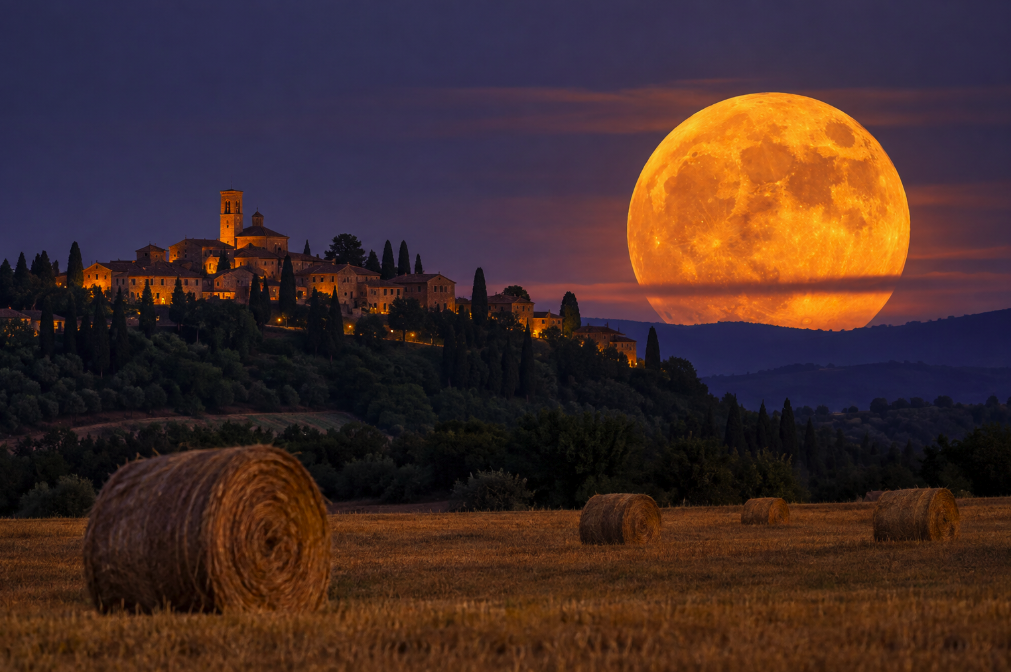
Few sights make the Moon seem more theatrical than an early-autumn moonrise. A huge amber disk appears behind trees, rooftops or distant hills, looking far larger than the Moon we see later in the night. It is easy to imagine that the Harvest Moon has physically swollen, moved dramatically closer to Earth, or acquired its golden color because of something special happening on the lunar surface. Almost none of that is true.
The Harvest Moon is not a separate astronomical type of Moon. It is simply the full Moon that occurs closest to the September equinox, which marks the beginning of astronomical autumn in the Northern Hemisphere. In 2026, the September equinox occurs on September 23 at 00:05 UTC, and the full Moon on September 26 is therefore this year's Harvest Moon. The name describes its place in the seasonal calendar, not a change in the Moon itself.
Why is it called the Harvest Moon?
The name comes from the relationship between moonlight, the season and traditional agricultural work. Before electric lighting transformed farming, bright moonlight after sunset could extend the useful working day during the busy harvest period. The effect was especially noticeable around the autumn equinox because of the geometry of the Moon's path across the sky.
Normally, the Moon rises on average about 50 minutes later from one day to the next, although the actual interval varies considerably with latitude and time of year. Around the Northern Hemisphere's autumn equinox, however, the angle between the ecliptic — the apparent path followed by the Sun and approximately by the Moon — and the eastern horizon can make successive evening moonrises occur unusually close together in time at mid-northern latitudes.
For several evenings around the full Moon, that meant useful moonlight could arrive relatively soon after sunset. Farmers did not suddenly receive a brighter or more powerful Moon; they benefited from favorable timing. This seasonal pattern helped give the Harvest Moon its enduring name and its association with fields, crops and the end of summer.
The definition also explains a small surprise: the Harvest Moon does not have to occur in September. Because it is the full Moon nearest the September equinox, it can occasionally fall in early October.
The giant Moon is mostly inside your brain
The most famous feature of a Harvest Moon rising over the horizon is also the most deceptive. It often looks enormous. Yet NASA points out that photographs made with the same camera settings show that the Moon's horizontal angular diameter is essentially the same near the horizon as it is when the Moon is high in the sky later that night.
This phenomenon is known as the Moon illusion, and humans have noticed it for thousands of years. Scientists still do not have one universally accepted explanation for exactly how the illusion works. The leading ideas involve visual perception: when the Moon sits beside familiar objects such as buildings, trees and mountains, our brain interprets its apparent size and distance differently than when the same disk is isolated in an empty sky.
Perspective cues may contribute. Objects on the horizon give the brain a landscape with an apparent depth, while a Moon high overhead has fewer familiar reference points. The result is striking enough that the rising Moon can feel dramatically larger even though a measurement says otherwise.
There is an easy experiment. Photograph the Moon near the horizon and again later when it is high in the sky, using the same focal length. Compare its diameter in the two photographs rather than relying on memory. The enormous growth largely disappears. In fact, atmospheric refraction close to the horizon can slightly squash the Moon vertically rather than enlarge it.
This illusion should not be confused with a supermoon. A supermoon is associated with a full Moon occurring when the Moon is relatively close to Earth in its elliptical orbit, so there can be a genuine difference in apparent angular size compared with a more distant full Moon. The horizon illusion, by contrast, can happen to any full Moon and is primarily a perceptual effect.
Its golden color, however, is real
The apparent size may be an illusion, but the orange, yellow or reddish color of a rising Harvest Moon has a physical explanation. When the Moon is close to the horizon, its reflected sunlight has to travel through a longer path in Earth's atmosphere before reaching your eyes. Shorter blue wavelengths are scattered more efficiently out of the direct line of sight, leaving a greater proportion of yellow, orange and red light.
It is related to the same basic atmospheric physics that gives sunsets their warm colors. Dust, smoke and other particles can intensify the effect, which is why one moonrise can look pale yellow while another becomes deep orange or copper. As the Moon climbs higher, its light travels through less atmosphere and the disk usually returns to its more familiar pale appearance.
This is also why not every reddish Moon has the same cause. During a total lunar eclipse, for example, Earth blocks direct sunlight from reaching the Moon and sunlight filtered and bent through Earth's atmosphere illuminates the lunar surface. IMOOND has previously explored why the Moon can turn red, including the very different geometry involved in an eclipse.
Long-lens photography can add another layer of confusion. Photographers often stand far from a foreground subject and use a telephoto lens to frame the Moon behind a building, person or mountain. The compressed perspective can create breathtaking photographs in which the lunar disk seems impossibly enormous beside terrestrial objects. The image may be perfectly genuine, but it does not reproduce the scale you would perceive with the naked eye from the same location.
A seasonal full Moon, not a mysterious lunar transformation
The Harvest Moon is compelling precisely because several ordinary phenomena arrive together. There is the predictable celestial geometry of the equinox season, the cultural memory of agricultural harvests, the warm atmospheric filtering of a low Moon and one of the most persistent illusions produced by human vision.
In 2026, the effect has a particularly neat calendar sequence for Northern Hemisphere observers: the September equinox arrives on September 23 at 00:05 UTC, followed by the full Harvest Moon on September 26. The exact time of moonrise depends on location, so the most dramatic view will come from checking local moonrise times and finding an unobstructed eastern horizon.
When the orange disk finally appears, it is worth remembering what you are actually seeing. The Moon has not suddenly inflated above the landscape. Its golden color is produced largely by the long journey of moonlight through our atmosphere, while its astonishing apparent size is being constructed by the visual system inside your head. The Harvest Moon is therefore both an astronomical event and a perceptual one — a familiar Moon made extraordinary by season, atmosphere and the way humans see the sky.